
Professional Photography Services: A Production Checklist for Businesses
- 3 days ago
- 10 min read
Updated: 17 hours ago
A successful commercial shoot is less about the shutter click and more about the weeks of logistical precision that happen before the first light is even switched on. You know that high-quality visuals are non-negotiable for your brand, yet the invisible variables of production often cause the most friction. From unexpected costs during retouching to the complexity of securing a filming permit for a shoot in a high-profile location or specific venue, managing professional photography services requires a balance of creative vision and meticulous project management.
It's frustrating when a production lacks consistency across a large team or misses a critical delivery deadline. At The Photography Co, we believe a photography partner should act as a steady, authoritative resource that handles these complexities so you don't have to. This article offers a practical framework for evaluating production quality and managing the logistics of a professional shoot. We'll cover how to build a clear creative brief, navigate essential regulatory requirements, and ensure your team receives high-resolution results on a predictable schedule.
Table of Contents
Defining Your Production Requirements and Brief
A successful project begins with a clear understanding of where your images will live. Whether you need high-resolution files for large-format print at the Dubai World Trade Centre or optimized assets for e-commerce, the final medium dictates the technical approach. A seasoned photographic agency functions as more than just a provider of images; it is a strategic partner that ensures your investment aligns with your commercial goals. Defining these requirements early prevents the friction of mid-production changes and helps in selecting the right professional photography services for your specific scale. You must also decide between a controlled studio setting, such as our base in Barsha Heights, or an on-location shoot that reflects your corporate environment.
Essential Components of a Photography Brief
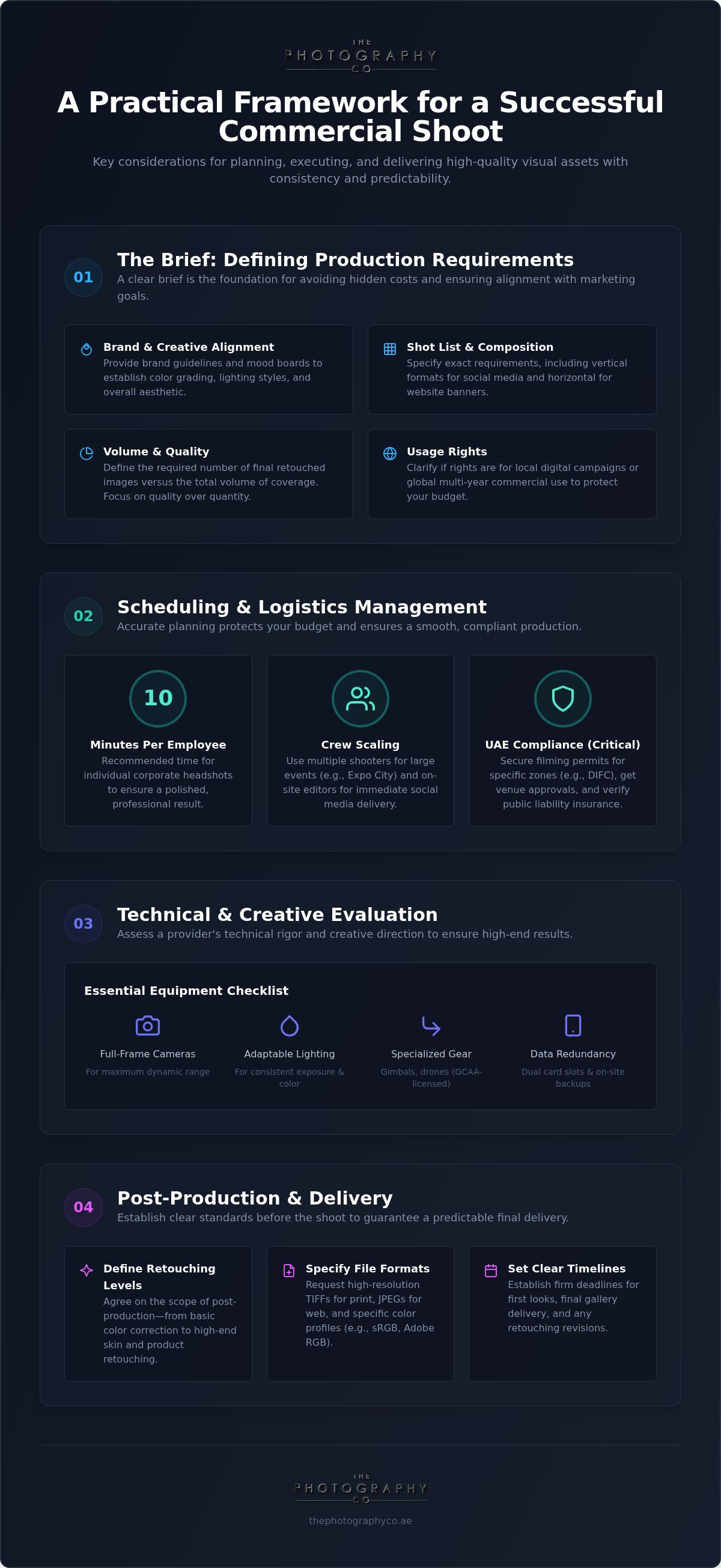
A robust brief is your most valuable tool for maintaining brand consistency. Start with brand guidelines and mood boards to align the creative team on color grading and lighting styles. You should also specify exact shot requirements. For instance, social media channels often require vertical orientations, while website banners demand horizontal compositions. It's also vital to define the required volume of retouched images versus the total coverage; focus on quality over quantity. Finally, define your usage rights. Some projects only need digital rights for a local campaign, while others require global commercial rights for multi-year use. Clear boundaries here protect your brand and your budget.
Estimating Time and Crew Requirements
Accuracy in scheduling protects your budget and your team's time. For corporate photography sessions, we recommend allowing approximately 10 minutes per employee to ensure a polished, professional result. Large-scale summits often require multiple shooters to cover simultaneous breakout sessions at venues like Expo City. If your marketing team needs immediate social media delivery, consider adding an on-site editor to the crew. This allows for first-look highlights to be processed and delivered while the event is still active. Establishing these delivery deadlines early ensures the final gallery arrives exactly when your campaign needs it, allowing your internal teams to stay on schedule without the stress of missing assets.
Technical and Creative Evaluation Criteria
Selecting professional photography services involves more than just browsing a highlights reel. You need to look for consistency in lighting and composition across entire galleries, not just a few standout shots. High-end production requires a technical rigor that ensures every image in a 200-photo set maintains the same color temperature and exposure. This is particularly vital for product photography, where reflective surfaces or intricate textures like jewelry require specialized macro lenses and precise light control. Understanding the breadth of Photographer duties helps you realize that their role includes technical problem-solving and equipment management long before the shoot begins.
Equipment and Technical Standards
High-resolution commercial outputs depend on the right tools. Ensure your production team uses full-frame sensor cameras; these provide the dynamic range needed for large-format displays or high-end digital campaigns. Lighting setups should be adaptable. They must handle a range of skin tones and product materials without losing detail in the highlights or shadows. For projects requiring movement or scale, confirm the availability of specialized tools. This might include gimbals for stable video or GCAA-licensed drones for aerial views of a new development in DIFC. Don't forget to ask about data redundancy. A professional team always shoots to dual card slots and maintains on-site backups to protect your investment from hardware failure.
Assessing Creative Direction and Style
When evaluating professional photography services, remember that technical skill is only half the equation. The ability to provide creative direction is what separates a technician from an artist. Your photographer should be able to offer posing guidance that feels natural and aligns with your brand's existing visual identity. Whether you require a high-key corporate aesthetic for a team at the Dubai World Trade Centre or moody lifestyle imagery for a boutique brand, the studio's portfolio should demonstrate this versatility. Ask about their experience managing large groups. High-pressure event environments require a lead photographer who can command a room while remaining unobtrusive. This level of portrait and headshot photography expertise ensures that even the most camera-shy executives feel confident and well-directed.
Logistics, Compliance, and Venue Management
Logistics are the invisible thread that holds a high-end production together. While the creative vision is what draws you to professional photography services, the administrative and logistical groundwork ensures that vision is realized without interruption. This includes securing filming permits and verifying that the production team holds comprehensive public liability insurance. Most corporate venues and hotels in Dubai require this documentation before any equipment is even brought onto the premises. Failing to address these compliance steps early can lead to costly delays or the immediate cancellation of a shoot by venue security.
Drone work adds another layer of complexity to the production process. If your project requires aerial views, it's essential to review GCAA regulations and specific venue permissions. Flying a drone in a restricted zone or near a major airport requires specific approvals that can take several business days to process. Working with a team that is already GCAA-licensed for drone operations simplifies this significantly; they understand the required safety protocols and the necessary advance notice for flight approvals. This foresight protects your project from legal complications and ensures the shoot remains on schedule.
Navigating UAE Permits and Regulations
Securing the right approvals is a non-negotiable part of the production cycle. You should allow sufficient lead time for National Media Council (NMC) or venue-specific approvals, particularly when shooting in high-profile business hubs like DIFC or Expo City. These locations often have their own internal permit systems and security protocols that must be navigated well in advance. Beyond the paperwork, ensure your crew is briefed on local photography etiquette and cultural sensitivities. Respecting the privacy of others in public spaces and understanding where photography is restricted is vital for maintaining a professional reputation while on-site.
Venue Coordination and On-Site Setup
A site visit is highly recommended for complex productions. This allows the team to identify potential lighting challenges and locate reliable power sources before the crew arrives. For events utilizing live streaming services, testing the venue facilities is a priority. Relying on guest Wi-Fi is rarely sufficient; instead, verify the availability of a dedicated, wired internet connection with stable upload speeds. Coordination with venue security is also a key step. Providing a list of equipment and crew names in advance ensures a smooth load-in process and guarantees that everyone has the necessary access badges to move freely through the venue.
Post-Production Standards and Delivery
The production cycle doesn't end when the lights are packed away; the post-production phase is where the technical precision of professional photography services truly manifests. It's the stage where raw data is transformed into brand-consistent assets through a structured workflow of editing and retouching. To ensure the final results meet your creative vision, you must define the level of work required and agree on file formats early. Whether you need high-resolution TIFFs for a large-scale display at the Dubai World Trade Centre or optimized JPEGs for a digital campaign, these specifications should be settled before the shoot begins. Establishing a clear timeline for the review and feedback process prevents bottlenecks and ensures the final approval happens on schedule.
Understanding the Retouching Workflow
Every genre of photography requires a different touch in the edit, and our in-house team in Barsha Heights manages this transition with meticulous care. Basic editing generally includes color balance, exposure adjustment, and cropping; this is the standard for high-volume event photography where speed and consistency are the priorities. Advanced retouching goes much deeper. For portrait and headshot photography, this covers detailed blemish removal and skin evening to ensure a polished, professional look. Commercial work for products is even more intensive. It often involves complex composite work, focus stacking, and meticulous background cleaning to ensure the product is the sole focus without any distracting reflections.
Delivery Timelines and Asset Management
Predictable delivery is just as important as image quality for maintaining your marketing momentum. Most professional sessions follow a standard turnaround of approximately 3 business days for the final retouched gallery. However, we understand that time-sensitive projects like PR launches or social media campaigns often require 'first-look' highlights within 24 hours. Clarifying these expectations early prevents delays in your rollout and keeps your internal teams aligned. You should also discuss the method of delivery. We provide a secure, private online gallery that allows for easy sharing and direct downloading of different resolutions. Finally, make sure to clarify the studio's policy on raw files. These unedited "digital negatives" represent an unfinished product and are typically not included in a standard delivery package.
Scaling Production with The Photography Co
Managing complex projects often becomes a burden when dealing with multiple independent freelancers. By choosing professional photography services that offer a coordinated in-house team, you eliminate the friction of fragmented communication. Our 12 years of experience and a track record of 18,000 clients have taught us that a unified workflow is the most reliable way to deliver consistent results. Whether you're launching a new product or organizing a regional summit, having photographers, videographers, and retouchers working under one roof ensures that your brand's visual language remains cohesive across every asset.
The Advantage of an Integrated In-House Team
An integrated team provides a level of quality control that's difficult to replicate with external contractors. From the initial planning stages to the final retouching, every member of the crew is aligned with the project's creative brief. This setup simplifies communication by providing a single point of contact, which is essential for managing the moving parts of multi-day productions. Our Barsha Heights studio serves as a central hub for national production, providing a base for high-end studio work while our field teams deploy across the UAE.
Scalability for Events and Campaigns
The ability to scale is critical for businesses operating in a dynamic market like Dubai. Choosing professional photography services that can scale with your needs ensures that whether you're hosting an intimate board meeting or a global summit at the Dubai World Trade Centre, the quality remains uniform. We can deploy multi-camera setups for large-scale exhibitions or provide a single specialist for corporate portraits. This flexibility allows you to combine high-end product photography with lifestyle content in a single production day, maximizing your time and budget. Beyond standard coverage, you can access specialized services such as interactive photo booths and GCAA-licensed drone work. By integrating videography and photography into one synchronized workflow, we ensure your brand alignment remains intact while capturing the full scope of your project.
Partnering for Production Excellence
Organizing a commercial shoot involves more than just selecting a creative style. It requires a disciplined approach to defining technical requirements, navigating UAE-specific permit regulations, and establishing clear post-production standards. By using a structured checklist, you ensure that every image delivered aligns with your brand's identity and arrives on schedule. This preparation transforms a simple photoshoot into a reliable engine for high-quality marketing assets that perform across digital and print channels.
Choosing the right professional photography services means finding an authoritative partner that manages these logistical complexities for you. With 12+ years of production expertise and a 4.9/5 client rating, our in-house team is built to handle everything from single executive portraits to multi-crew event coverage at venues like DIFC and Expo City. We've supported 18,000+ clients across the UAE, earning 10 industry awards for our commitment to craftsmanship and technical precision.
We look forward to helping you streamline your next production and capturing the results your business deserves.
Frequently Asked Questions
How many photographers are needed for a corporate conference?
The ideal crew size depends on your attendee count and the number of simultaneous breakout sessions. For a standard event with up to 200 guests in a single room, one lead photographer is usually sufficient. However, for large-scale summits at the Dubai World Trade Centre featuring multiple tracks, we recommend at least two shooters to ensure comprehensive coverage of keynote speakers and candid networking moments.
What is the standard delivery time for professional event photos?
Final retouched galleries are typically delivered within 3 business days of the event. We understand the need for immediate social media engagement, so we often provide a "first-look" selection of highlights within 24 hours. This allows your PR team to share high-quality assets while the event is still fresh in the minds of your audience and stakeholders.
Do professional photography services include raw files?
Professional photography services generally do not include raw files in a standard package. These unedited "digital negatives" are unfinished products that require specialized software and our in-house team's expertise to process correctly. We provide high-resolution, fully retouched JPEGs or TIFFs that are ready for immediate use in your marketing materials, ensuring every image meets our established quality standards.
Can a single team handle both photography and video production?
An integrated production team can certainly manage both photography and videography through a synchronized workflow. Utilizing a single studio like ours reduces the friction of managing multiple vendors and ensures your brand's visual identity remains consistent across all media. This coordinated approach is especially effective for complex productions where timing and crew communication are critical to capturing every key moment.
What is the difference between basic editing and professional retouching?
Basic editing focuses on global adjustments such as color balance, exposure, and cropping to ensure a clean, natural look. Professional retouching is a more intensive process that involves detailed refinements like skin evening, blemish removal, and background cleaning. While basic editing is ideal for high-volume event coverage, high-end retouching is essential for corporate headshots and product imagery where technical perfection is required.
Are permits required for commercial photography in public spaces?
Commercial shoots in the UAE almost always require permits from the National Media Council (NMC) or specific venue authorities. Locations such as DIFC, Expo City, and Dubai Design District have their own internal approval systems and security protocols. Our team helps navigate these requirements to ensure your shoot is legally compliant and proceeds without interruption from local security or municipal officers.
How long does a corporate headshot session take per person?
We recommend scheduling approximately 10 minutes per employee for a professional headshot session. This timing allows the photographer to provide posing guidance, adjust lighting for different features, and capture a variety of expressions. Rushing this process often results in stiff, unnatural images, whereas a brief but focused session ensures every team member feels comfortable and looks their best.
What internet requirements are needed for a professional livestream?
A professional livestream requires a dedicated, wired internet connection with a stable upload speed of at least 10Mbps for a 1080p broadcast. Relying on venue Wi-Fi is risky due to potential fluctuations in signal strength and user congestion. We always perform a site visit to test the local infrastructure and coordinate with venue IT teams to secure a reliable, uncontended line for your broadcast.


Comments